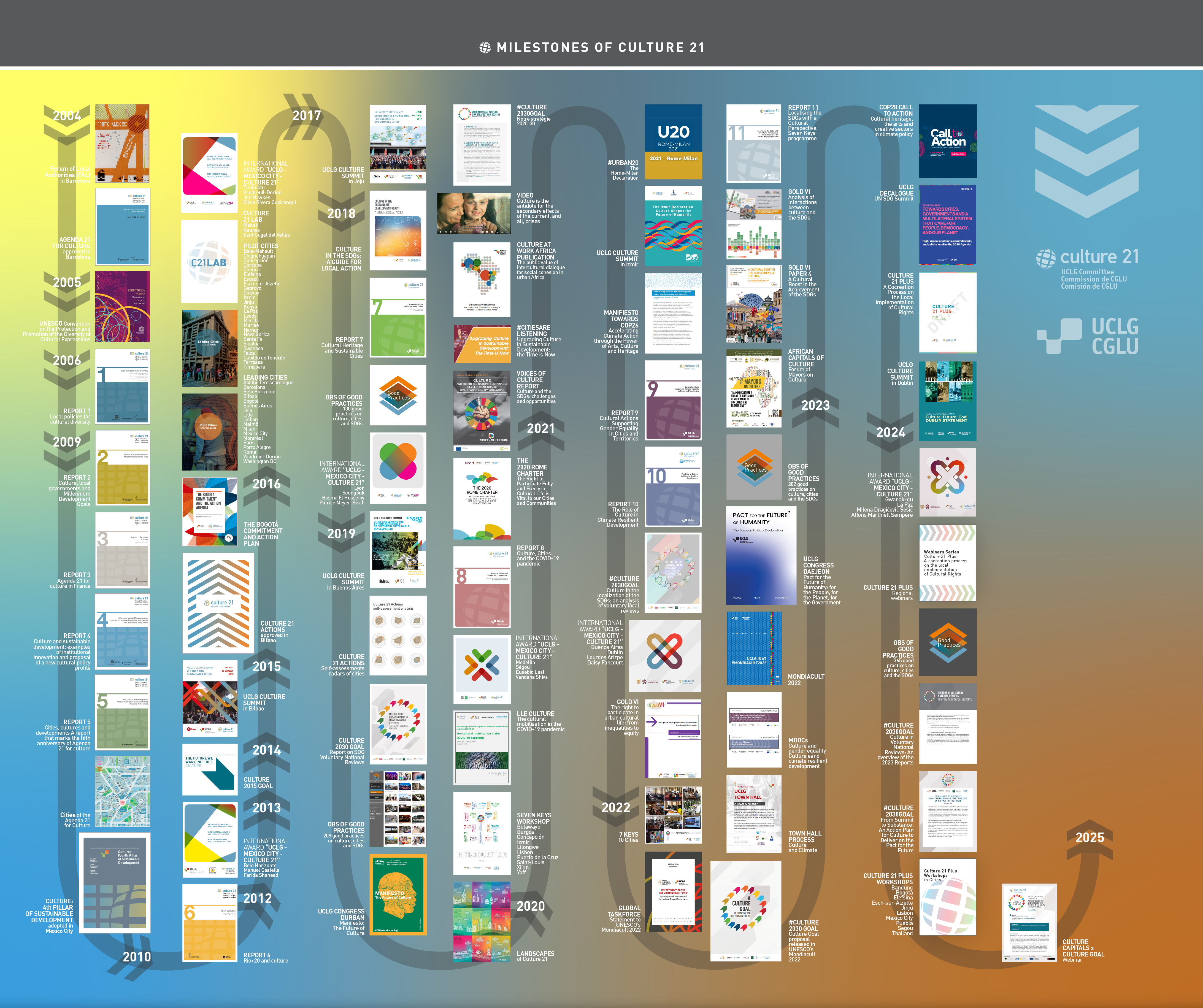

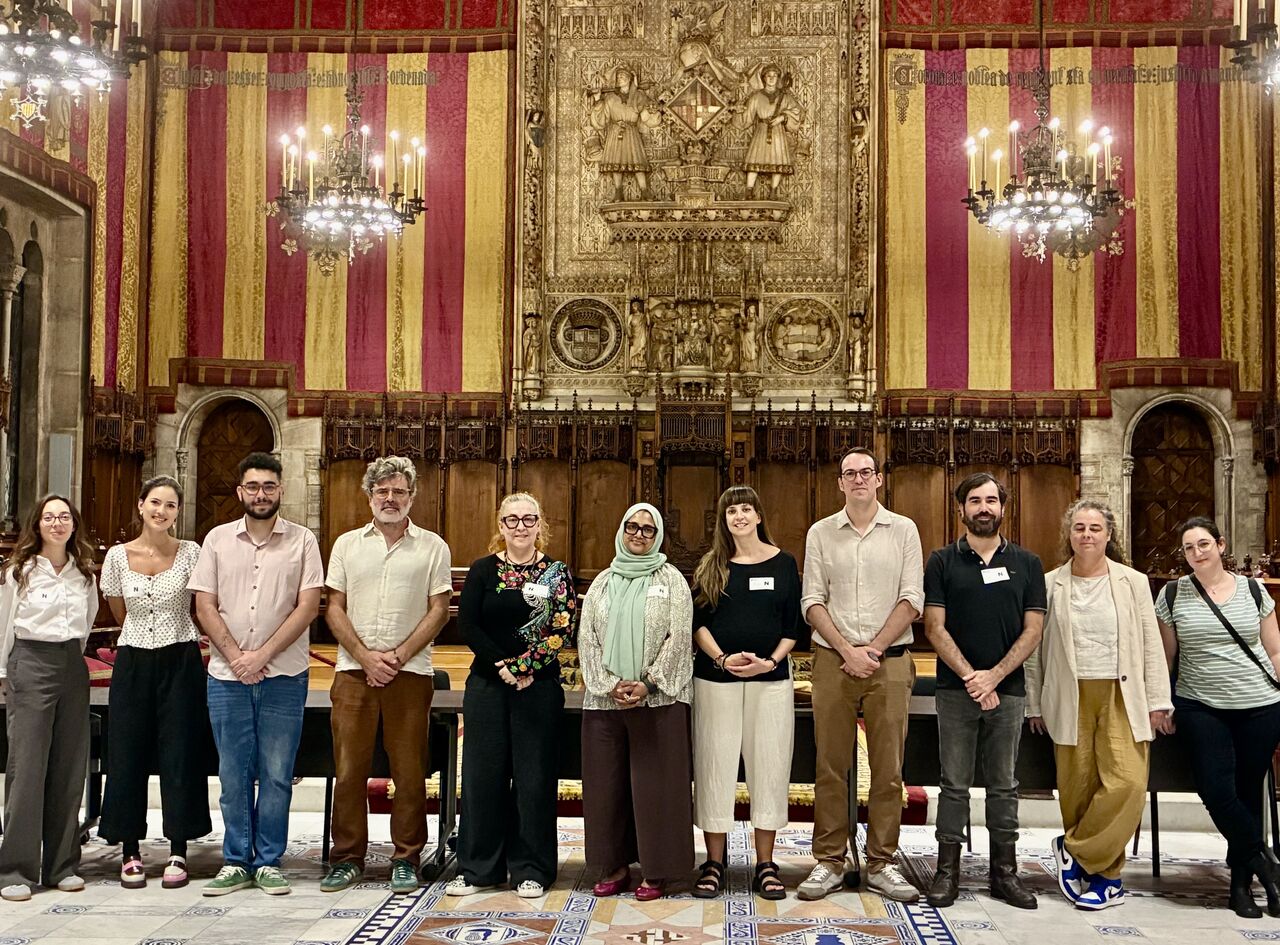
2025-2029

Imagen
2020-2024
Fletxa 2025

January. Organisation of Culture 21 Plus tests in the UCLG Eurasia and UCLG MEWA (Middle East and West Asia) regions.

February. 17-21 February, UCLG Annual Retreat & Campus in Barcelona.

Celebration of 22th the annual meeting of the Culture Committee on 27 February, online (see the report in this page).

March. Publication of the Committee’s contribution to the 7th Global Report on Local Democracy and Decentralisation (GOLD VII): “How cultural rights can enable practices of care”.

First Agora meeting of the Culture 2030Goal campaign, on 24 March, and implementation of the “Roadmap 2025” of the campaign.

April. Approval of the Culture 21 Plus, our global toolkit on Cultural Rights in Sustainable Development, at the UCLG Executive Bureau in Seville. 

May. Celebration of the 21th anniversary of the Agenda 21 for culture on 8 May, online. Release of this poster.

July. Global advocacy on the Culture Goal: #Culture2030Goal side-events in the context of the UN HLPF 2025.

Publication of the report “Culture in the 2025 Voluntary National Reviews: Culturally informed, culturally grounded, culturally powered”.

Launch of the document “The Culture Goal in brief”.

September. Organisation of the 6th UCLG Culture Summit in Barcelona. Release of the Statement “Culture is Always in the Answer” and the final report.

Culture2030Goal campaign: launch of the documents “The Culture Goal, from Necessity to Reality” and “The Analytical Report on the Culture Goal, its Targets and Indicators”, at the UCLG Culture Summit on 27 September 2025. 

Global advocacy on the Culture Goal: #Culture2030Goal side-events in the context of UNESCO’s Mondiacult 2025 (29-30 September and 1 October 2025).

Contribution to the Civic Agora, organised by the City Council of Barcelona, the Government of Catalonia, the Provincial Council of Barcelona and the Ministry of Culture of Spain 

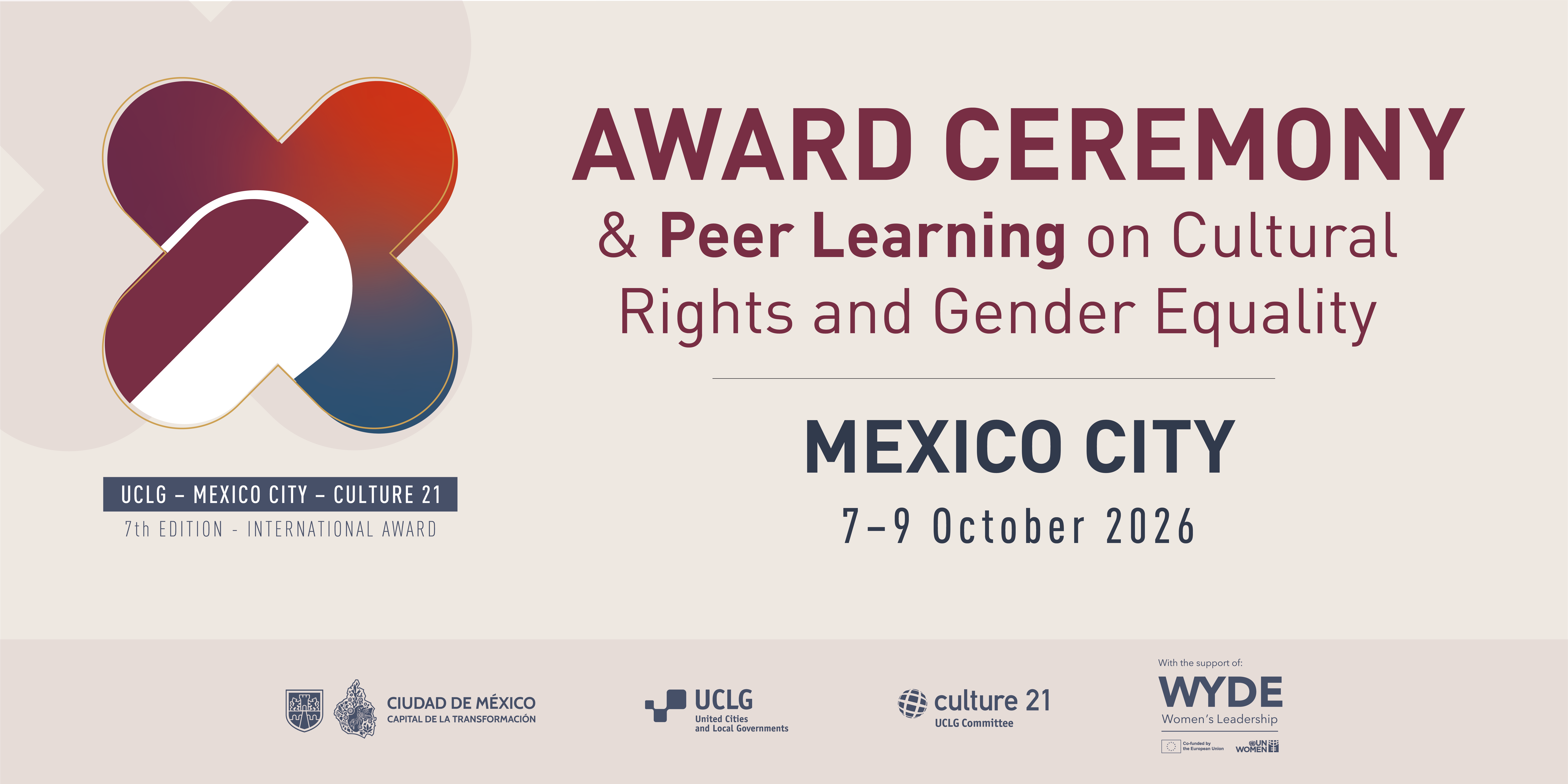
December. Launch of the 7th edition of the International Award UCLG – Mexico City – Culture 21.

Agora meeting of the Culture2030Goal campaign, 11 December, online.

Addition of new good practices to the OBS of good practices.

Culture 21 Plus (2026)

Imagen
Culture 21 Plus: Our framework for Cultural Rights and Sustainable Development

Culture 21 Plus

A renewed commitment to making culture central in sustainable cities and communities.

Culture 21 Plus is our framework document, guiding cities and territories to connect culture with
sustainability, human rights and local development.

The Culture 21 Plus Frame, in detail

Culture 21 Plus is structured around 6 fields and 30 thematic areas, covering how culture connects with
rights, communities, prosperity, territories, nature and governance.

It offers cities and local governments worldwide a shared framework, useful to:

  1. conduct self- assessment processes of the current state of local cultural policies
  2. design local cultural strategies based on cultural rights and sustainability.

Explore the full framework document.

Imagen
Get your Culture 21 Plus INITIAL ROADMAP in a minute

Culture 21 Plus Initial Roadmap

Culture 21 Plus Initial Roadmap is a new, free of charge, global digital tool that turns your city's cultural
priorities into a concrete action plan — in just a minute!

How it works:

  • Choose your cultural priorities.
  • Share the cultural vision of your city for 2050 in one sentence.
  • An algorithm built on the Culture 21 Plus framework will analyse your input and instantly generate
    your tailored initial roadmap

What you get — for free:

  • In just a minute, you will receive a 3-page PDF with your Culture 21 Plus Roadmap
  • 6 Priority Actions tailored to your city
  • 3 Strategic Pathways to work on in the short term
  • Options to further engage with the Culture Committee of UCLG and our programmes

Start your journey now!

Imagen
A cocreation process on the local implementation of Cultural Rights

Built with cities, for cities

Culture 21 Plus was not designed behind a desk. It was co-created with cities and regions from all corners
of the world.

From 2023-2025, through a wide range of consultation and on-site tests, the framework was refined to
reflect the real priorities and challenges that local governments face when placing culture at the heart of
sustainable development. The Culture 21 Plus was approved at the UCLG Executive Bureau in Seville, April
2025.

Do you have questions about the process? Check the FAQs below. In addition, you will find below the
reports from the test workshops that have been carried out.

The new Charter-Agenda for Human Rights in the City

UCLG adopted the New Global Charter-Agenda for Human Rights in the City at its World Congress in Tangier (25 June 2026). This work was carried out by our colleagues from the Committee on Social Inclusion, Participatory Democracy and Human Rights (CISDPDH). The Charter-Agenda is an updated global framework designed to guide local and regional governments in promoting human rights at the local level. It reaffirms the role of local and regional governments as guarantors of human rights and recognizes 37 human rights in the city, each with concrete steps for its implementation.

The Charter-Agenda offers an integrated vision of human rights in the city. In addition to the fundamental rights already recognized internationally, it incorporates new human rights, covering essential services and social, economic, cultural, environmental, and democratic rights – with particular attention to groups that continue to face discrimination and obstacles in exercising their rights. Above all, this is not just a declaration of principles, but a political and practical tool, providing concrete principles, commitments, and recommendations for local action.

This document is the result of several years of collaborative work, bringing together cities from every continent, international networks, civil society organizations, universities, and experts—a diversity of actors that constitutes its greatest strength.

Sara Hoeflich

picture of Sara Hoeflich

It is with profound sorrow that the UCLG World Secretariat shares the passing of our dear colleague, Sara Hoeflich, Assistant Secretary General and long-standing Director of Learning.

Over the past months, Sara faced an incurable illness with remarkable grace and serenity. It took her from us far too soon.

Sara illuminated our movement with her creativity, generosity, and unwavering belief in humanity’s capacity to learn, to care, and to build a better present and future together. She joined the municipal movement in the early 2000s after a distinguished career in international development that had connected her with communities across continents. Wherever she went, she brought curiosity, compassion, and an extraordinary ability to bring people together.

Sara was a key person in the life of the UCLG Culture Committee: we enjoyed her generous company in the development of the Seven Keys, the Online Courses, the most recent reports and studies and, in general, the daily work of our programme. We will continue to love her by carrying forward the values she embodied. We will honor her work and her unwavering dedication by continuing to learn through collaboration, by nurturing peer-to-peer exchange and mutual learning, and, above all, by never losing faith that together we can make the world a better place.

Her beloved family has kindly allowed us to share this beautiful photograph, which captures the extraordinary light she brought into every room and every life she touched.

Today, the World Secretariat and the entire UCLG movement mourn the loss of a remarkable colleague, mentor, and friend. In the days and years ahead, we will continue to celebrate Sara’s life by strengthening cooperation, advancing learning, and fostering solidarity wherever we can. In doing so, her light will continue to guide us.

CULTURAL MOBILITY FLOWS REPORT, BY ON THE MOVE

Cultural Mobility Flows Report

On The Move, the organisation that supports interantional mobility for artists and professionals, has published a new report: "Cultural Mobility Flows: Cities as Enablers of International Cultural Mobility". The report, authored by Yohann Floch, Jordi Baltà Portolés, Claire Rosslyn Wilson and Ariane Bieou, grows out of the Cultural Mobility Webinar organised by On the Move in collaboration with HowlRound, which brought together practitioners, policymakers and advocates, including the UCLG Culture Committee, to explore how municipalities are developing travel grants, bilateral and multilateral exchange programmes, artist residencies and other initiatives that support the international mobility of artists and cultural professionals.

This report is addressed to all cultural stakeholders with a view to providing concrete and actionable recommendations. These recommendations are grounded in the sources and practices analysed throughout and reinforce observations and proposals emerging from relevant policy documents addressing the needs and challenges of artists and cultural professionals across a wide range of contexts. They point towards policy changes, funding initiatives and collaborative frameworks that can enhance international opportunities for all cultural practitioners, with particular attention to those who face the greatest structural barriers to mobility.

Access this link to download the report.

Call for contributions on assessing the implementation of cultural rights

Cultural rights

The United Nations Special Rapporteur in the field of cultural rights, Alexandra Xanthaki, is calling for contributions for her upcoming report to the General Assembly, to be presented in October 2026, in which she will propose guidance on how to assess efforts to implement cultural rights.

The Special Rapporteur intends to build on the existing body of work to propose elements that should help States, institutions, decision-makers but also other stakeholders, to set benchmarks for accountability and measure progress in the implementation of cultural rights for all. The aim is that these elements may also contribute and strengthen the general framework of human rights indicators, the tools and indicators for specific cultural rights and the advocacy for a better mainstreaming of cultural rights in the 2030 sustainable development agenda or any new agenda for development after 2030, in particular through a stand-alone Culture Goal.

Access here the questionnaire that she has prepared, which is being sent out to States, United Nations agencies, national human rights institutions, academics, cultural workers and practitioners, as well as civil society organizations for their consideration. The deadline for submitting contributions is 22 May 2026.

“Cultiva México”. Database of Good Practices in Cultural and Artistic Management in Mexico

Cultiva México

On Tuesday 28 April 2026, the Ministry of Culture of the Government of Mexico, through the Directorate-General for Cultural Training and Management, recognised the projects selected under the “Cultiva México. Database of good practices in cultural and artistic management”, which seeks to identify and recognise good practices in cultural and artistic management that generate a common good, have a positive impact on their environment and promote diversity and cultural rights.

The call for proposals, which was supported by the UCLG Culture Committee, identified collective initiatives that promote a positive impact on their local communities, with a view to incorporating them into Mexico’s first Database of Good Practices in Cultural and Artistic Management. Mexico’s Database of Good Practices in Cultural and Artistic Management includes initiatives that focus on creating spaces for music, reading, the performing arts, community organisation processes, processes associated with intergenerational learning, and the recovery of community memory.

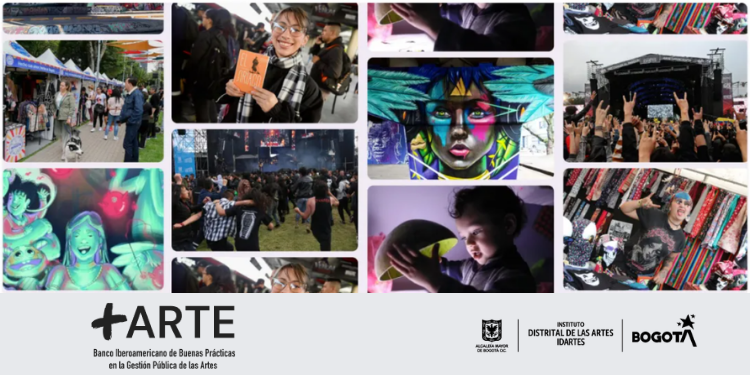
With the aim of creating an International System of Databases of Good Practices, Cultiva México will also support initiatives recognised by IDARTES’ Ibero-American Database of Good Practices and by the “OBS” Database of Good Practices of the UCLG Culture Committee, promoting their sustainability, professionalisation, technical management and exchange of knowledge to broaden their impact.

Final Webinar: Capitals of Culture Working Together

2026_webinar_capitals_of_culture_en

On 28 April 2026, the UCLG Culture Committee held the final webinar for the Capitals of Culture Working Together programme, marking the culmination of three years of continued international collaboration.

Key milestones throughout the programme included capacity-building workshops and webinars, including the Seven Keys, the Youth Lab and the Culture 21 Plus tools; a structured methodology for a permanent African Capital of Culture initiative; connections between local action and global challenges through the Culture Goal; and an active participation of main actors in major international City and Regions fora and events.

The European Commission’s Directorate-General for International Partnerships (DG INTPA) played a central role in making this initiative a reality, enabling an ambitious vision to be transformed into a practical, global-scale endeavour.

For further information on the actions carried out throughout the program, please, click here.

Capitals of Culture Working Together

Imagen
Capitals of Culture 105mm banner

UCLG works globally to boost the conversation on culture in development. At least since 2017 (at the second Culture Summit), this aim includes the creation of synergies among Capitals of Culture. In 2023, the European Commission and UCLG signed an agreement to develop the programme “Capitals of Culture, Share, Learn and Advocate Together”. 

The programme included: (a) capacity-building workshops and webinars, including the Seven keys, the Youth Lab and the Culture 21 Plus, (b) a structured methodology for a permanent “African Capital of Culture” initiative, (c) the connection with the global challenge through the Culture Goal, and (d) the participation of main actors in major international “City and Regions” Fora and events.

A final event will take place on 28 April 2026.
 

THE FINAL EVENT: A WEBINAR ON 28 APRIL 2026

The final event of the programme “Capitals of Culture Working Together” took place on 28 April 2026 with this agenda. The event involved all the partners of the programme. A draft report of the webinar is available here.


CAPACITY-BUILDING WORKSHOPS AND WEBINARS
A STRUCTURED METHODOLOGY
Imagen
Logo UCLG-Africa bilingue FRA et ENG

The first meeting of the Culture Committee of UCLG-Africa took place in Brazzaville in July 2025. This document is the Synthesis of the Agreements (only in French, it will be soon avaliable in English).

Imagen
Logo UCLG-Africa bilingue FRA et ENG

The second meeting of the Culture Committee of UCLG-Africa took place in Nouakchott in March 2026. This document is the Synthesis of the Agreements (only in French, it will be soon avaliable in English).

Imagen
logoa Capitals quadrat ENG

The Terms of Reference of the African Capital of Culture, approved in Nouakchott, at the second meeting of the Culture Committee of UCLG-Africa. (En français, ici.)

Imagen
logoa Capitals quadrat ENG

This is the Synthesis Note to the Terms of Reference for the African Capital of Culture. (En français, ici.)

Imagen
Logo UCLG-Africa bilingue FRA et ENG

This is the work plan 2026-2028 of the Culture Committee of UCLG Africa 

Imagen
logoa Capitals quadrat ENG

This is the dossier with the main elements for the consideration of Brazzaville as the Second African Capital of Culture

THE CAPITALS ADVOCATE FOR A CULTURE GOAL
Imagen
logoa Capitals quadrat ENG

This is the report "Capitals of Culture Engaging for the Culture Goal", written by Sylvia Amann.

EVENTS
Imagen
Acoc Forum of mayors Rabat 2023

The first Forum of Mayors of the African Capital of Culture took place in Rabat in May 2023.

Imagen
Culture Summit Dublin 2023 ENG

The UCLG Culture Summit in Dublin took place in November 2023.

Imagen
Culture Summit Barcelona 2025 ENG

The UCLG Culture Summit in Barcelona took place in September 2025

THE "CAPITALS" INITIATIVES

SHARE