
CAMOC Barcelona 2021

CAMOC Barcelona 2021

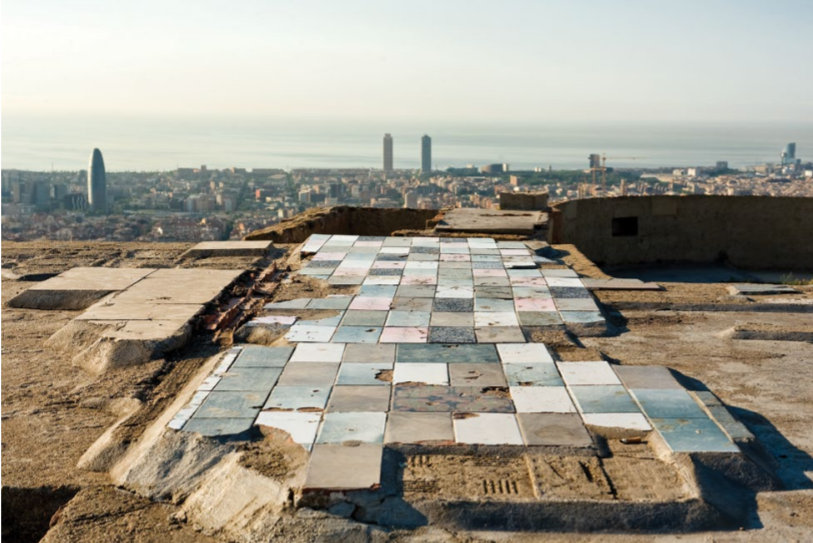
The CAMOC 2021 Barcelona annual conference, entitled "Connecting Cities, Connecting Citizens. Towards a Shared Sustainability" will be organised on next 1-3 December 2021. 

Technological change, accelerated by the pandemic, and the current social and political uncertainty further emphasize the importance of cities and the urban network in the global future. In this context, the reinvention of city museums can play a key role in building a democratic world with more social justice and respect for the planet. For this reason, the CAMOC 2021 meeting in Barcelona aims to deepen the role that city museums can play as strategic institutions of urban, social and cultural cohesion that make it possible to connect cities and citizenship in favor of a shared sustainability as a common social and democratic project and, also, as knowledge centers and polarities for urban development.

CAMOC and MUHBA (Barcelona History Museum) propose three days of shared work to reflect on the main areas of a new urban museology for the 21st century, to move from the “city museum” to the “citizens’ museum”, with solid foundations based on research in the fields of urban history, heritage management and citizen participation. The program is organized in three sessions, which will revolve around three concepts: museum work, reporting the city, and enhancing citizenship, plus a workshop on city museums in fast-growing metropolises.

In this context, you can submit your proposals until September 25. Check out the call for papers and the provisional conference program at the following link:​ Call for papers and preliminary programme


HLPF side-event 2021

HLPF side-event 2021

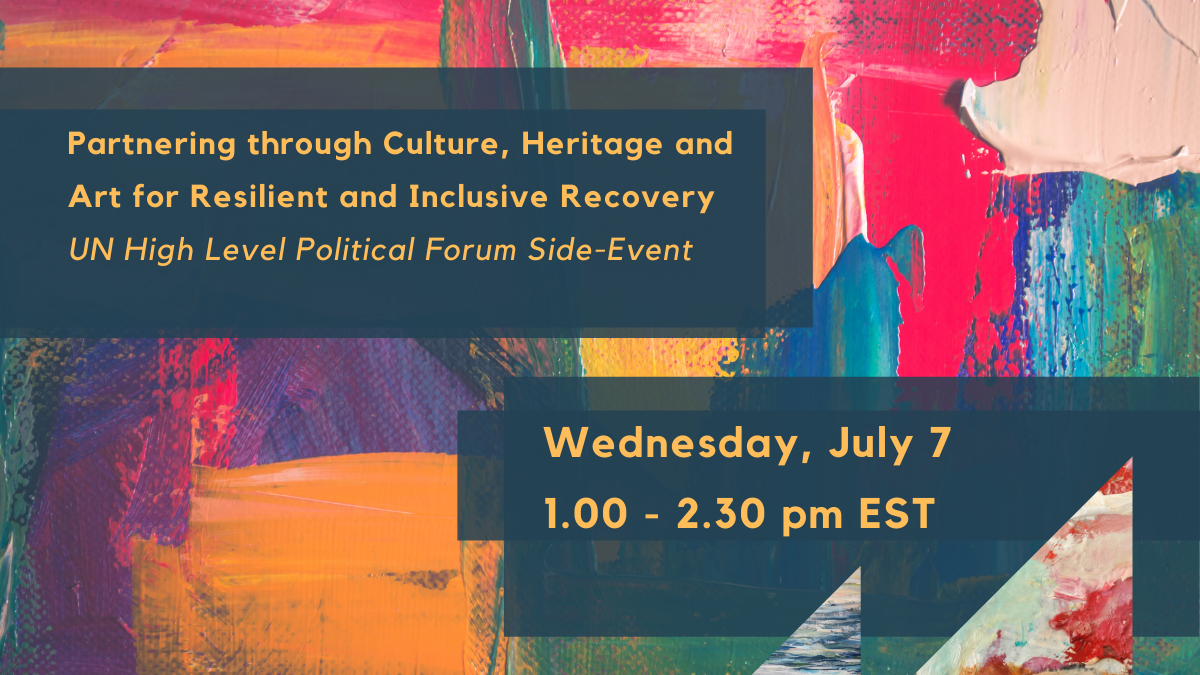
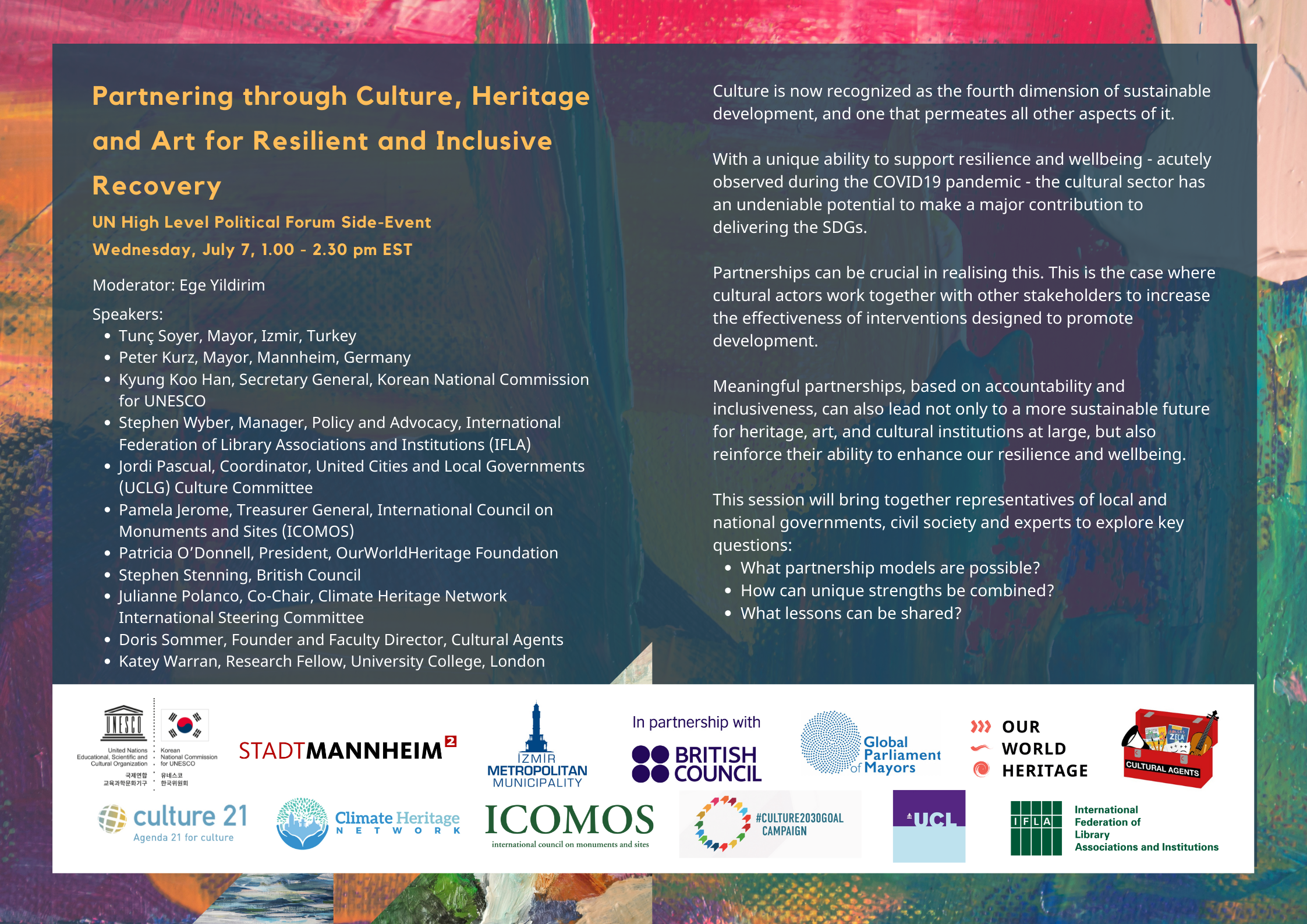
IFLA and partners organise a side-event entitled 'Partnering through Culture, Heritage and Art for Resilient and Inclusive Recovery' at the HLPF 2021 on next 7 July. This event follows on from the High-Level Event organized by the President of the UNGA on 21 May, 2021, and the #Culture2030Goal side event at HLPF 2020.

The session will look at how partnerships with the culture sector can accelerate sustainable development in the Decade of Action, while supporting the cultural life of our communities, and safeguarding our heritage for future generations. What partnership models are possible? How can unique strengths be combined? What lessons can be shared? The session will bring together representatives of local and national governments, civil society and experts, each with experiences that can help build a global sense of how partnering through culture can power resilient and inclusive recovery.

More info available at https://sustainabledevelopment.un.org/index.php?page=view&type=20000&nr=...

Registrations here.

See the programme here:

Conference on mega-events and heritage

Conference on mega-events and heritage

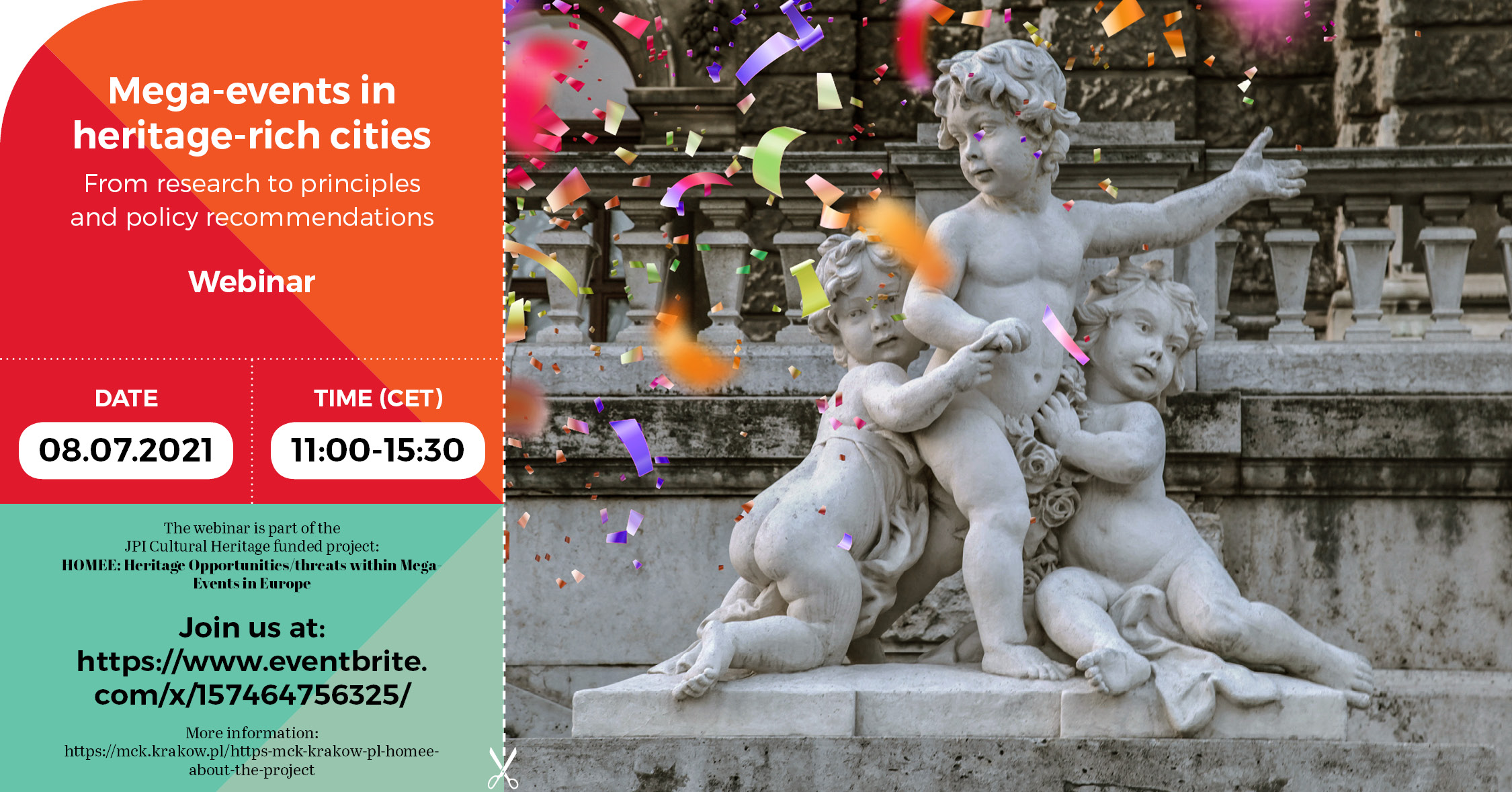
The Politecnico di Milano organised on 8 July 2021 (11:00-15:30 CEST) the webinar "Mega-events in Heritage-rich Cities. From research to principles and policy recommendations".

Mega-events have been changing their relationship with the city, now more commonly using existing infrastructures and facilities. In Europe and other parts of the world, this may put historic city centres and broader heritage assets under stress. How can cities rich in culture host mega-events without putting their own heritage at risk? How can mega-events become effective ways to promote and protect tangible and intangible heritage?

The webinar introduced and launched the “Charter for Mega-events in Heritage-rich Cities” that responds to these questions. The Charter derives from the HOMEE research project that investigated case studies across Europe and involved organizations, experts and professionals in the field. It provides principles and policy recommendations for decision makers and event organisers to avoid typical pitfalls while cooperating with the heritage sector.

Find the list of speakers here.

More info at https://www.eventi.polimi.it/events/mega-events-in-heritage-rich-cities-...

New report on the right to education as a cultural right

New report on the right to education as a cultural right

The UN Special Rapporteur on the right to education, Ms. Koumba Boly Barry, just published a new report of the on the cultural dimensions of the right to education or the right to education as a cultural right. The report is available in all UN languages.

Please find it here: OHCHR | The cultural dimensions of the right to education or the right to education as a cultural right. A friendly version of the report will soon be available in English, French and Spanish.

The report was officially presented during the 47th session of the Human Rights Council on Thursday 24 and Friday 25 June 2021 in the morning and direct live on UN Web TV.

More information: https://www.ohchr.org/EN/Issues/Education/SREducation/Pages/CulturalDime...

UNESCO Call for Action

UNESCO Call for Action

On this 23 June 2021, UNESCO releases a Call to Action to celebrate the 10th Anniversary of the 2011 UNESCO Recommendation on the Historic Urban Landscape.

The HUL Anniversary Event not only marks the start of the 2021 celebration but serves as a catalyst for greater adoptions of the HUL approach. Serving as a platform to share lessons learned from COVID-19 and to resume discussions on the future of urban management, topics such as public space, renovations, tourism, infrastructure and livelihoods will be explored. The Recommendation will provide an overall framework, while local needs and resources determine the implementation form.

UNESCO invites all cities and towns to join the Call for Action to raise awareness about the Recommendation and to accelerate inclusive urban and heritage management through HUL.

Join the Call to Action!

More information: http://whc.unesco.org/en/events/1596

New report on culture and climate resilient development

New report on culture and climate resilient development

The world cannot afford divergent ‘sustainable development’ and ‘climate action’ agendas but rather these two must be fully integrated. In line with Culture 21 Actions (which includes a full Commitment devoted to “cultural factors as accelerators of environmental responsibility”), we are promoting a report on “The Role of Culture in Climate Resilient Development”.

The report “Culture in Climate Resilient Development” is an attempt to document the initiatives of cities and local or regional governments from all continents on cultural policies, sustainable cities and climate resilient development. It includes a diverse pack of case studies from all across the world and addressing the whole set of the 2030 Agenda Sustainable Development Goals (SDGs). This document was open for contributions until July 2021.

This report has been commissioned by the UCLG Culture Committee in collaboration with the Climate Heritage Network (Working Group 5). It has been jointly coordinated by Andrew Potts (Climate Heritage Network - CHN) and the Secretariat of the Committee on Culture of UCLG.

The report was presented as a draft on 9 September 2021 at the UCLG Culture Summit held in Izmir and Online, at the workshop session “Culture and the Climate Emergency. Local Experiences towards COP26”. The final version was published on 5 November 2021.

#culture2030goal vision document

#culture2030goal vision document

No Culture No Future  | #Culture2030goal Campaign launches its strategy document

If you believe that there is no future without culture and that the cultural ecosystems should be integrated in both short-term recovery and long-term development strategies, support the #Culture2030goal campaign. With the launch today of its strategy document the group (where UCLG and its Committee on Culture is a member} takes this opportunity to extend invitation to interested stakeholders to join the campaign and support its actions.

The #Culture2030goal campaign calls for the recognition of culture as the fourth pillar of sustainable development and advocates for mainstreaming culture across the global development agenda. The campaign also aims to include culture as a distinct goal in the post 2030 development framework.

It is formed by several international cultural networks united to advocate for the role of culture in sustainable development. It is the continuation of the #Culture2015goal Campaign, created in 2013 to call for culture to be included in the United Nations 2030 Agenda for Sustainable Development (and the SDGs) that was adopted in September 2015.

Over the past two years, the Campaign has gained important momentum. A study on the place of culture in the implementation of the 2030 Agenda, published in September 2019, highlighted good practices around the world. However, it also underlined that much needs to be done to realise the potential of culture as a pillar of sustainable development. In the context of the UN’s Decade of Action, the study underlined that culture needs to be recognised more broadly as a crucial development accelerator in order to realise its potential.

Published more recently, the Campaign’s #CultureCOVID19 Statement entitled ‘Ensuring culture fulfills its potential in responding to the COVID-19 pandemic’ not only highlighted the need to support culture during the pandemic, but also demonstrated how culture could both promote wellbeing in the immediate term, and a stronger, fairer recovery in the longer term. This received noteworthy attention from various organisations, including UNESCO and the WHO, culminating in the excellent result of an endorsement by the President of the UN General Assembly.

You can support the #Culture2030goal campaign by joining  as ‘Supporters’, here you can learn more how you can do it. Cultural networks with significant international reach and a leadership role in their field can join the Campaign’s small and dedicated steering group, find out more.

The #Culture2030goal campaign strategy document is available in English, French and Spanish.

Check more about the campaign on its website and follow #Culture2030goal on Twitter for more updates.

The Rome Charter: a year after

The Rome Charter: a year after

On last 28 May 2021 from 15h00-16h30 CEST, the Committee on Culture of UCLG together with the City of Rome and in collaboration with Azienda Speciale Palaexpo organised the event "The Rome Charter an informal and multi-voiced conversation one year after" with the aim of debating the place of cultural rights in short-term, mid-term and long-term development and post-crisis recovery strategies.

Check out here the programme of the event. 

Speakers 

 
Link

Programme

Speakers 

 
Link

Watch the session again

Culture At Work Africa : new publication

Culture At Work Africa : new publication

In the context of our activities as a member of the Culture At Work Africa initiative consortium, we are happy to announce the release  of the final publication "Culture At Work Africa: the Public Value of Intercultural Dialogue for Social Cohesion in Urban Africa".

The publication addresses the lack of documents or reports that illustrate in practice, at work, how culture changes our societies in an empowering way. It explains the reality of 15 African countries and provides details about 33 projects and programmes co-funded in the context of the Culture At Work Africa initiative; from the frames and narratives to the final outcomes and outputs, from the successes to the difficulties experienced. All the projects described in the report can be understood – should be understood – as learning experiences. Beyond this, the publication aims at providing an overall conceptual analysis of the main thematic issues, challenges and opportunities addressed by the sub grantees. 

It also provides recommendations for subsequent activities at local, national, regional or African and EU level. Along with providing valuable lessons in addressing local issues and challenges, this publication also aims at documenting, promoting and providing international visibility on the 33 projects and programmes co-funded in the context of the initiative. With this publication, we aim at providing both a printed and digitalised record of the experiences of both the Consortium and the pool of subgrantees of the Culture at Work Africa initiative.

More information on the Culture At Work Africa initiative: www.cultureatworkafrica.net/

Speakers 

 
Link

Publication

MC2CM

MC2CM

The Committee on culture collaborates with the Mediterranean City-to-City Migration Project (MC2CM), implemented by the UCLG Migration Community of Practice, ICMPD and UN-Habitat, and funded by the European Commission and the Swiss Agency for Development and Cooperation.

MC2CM brings together cities and experts on migration issues, human rights, and sustainable urban development in order to improve migration governance at the city level. MC2CM promotes peer-to-peer dialogues and actions to support learning on specific urban challenges such as social cohesion, intercultural dialogue, employment, housing rights and provision of basic services for migrants.

On 11-12 December 2019 the Committee on culture participated at the MC2CM thematic learning event “Cultural Policies: a vector for migrants’ inclusion in urban context” held in the city of Casablanca, which explored the ways local governments can implement a cultural approach to migration as vector of inclusion and opportunities at the local level. Based on this experience, Jordi Baltà Portolés, cultural consultant and researcher at Trànsit Projectes (Barcelona) and an advisor to the UCLG Committee on Culture conducted a report with the same title, benefiting from the contributions of MC2CM city focal points and partners, as well as from expert Phil Wood’s background document for the event.

More information on the MC2CM project here.

Speakers 

 
Link

Report

SHARE