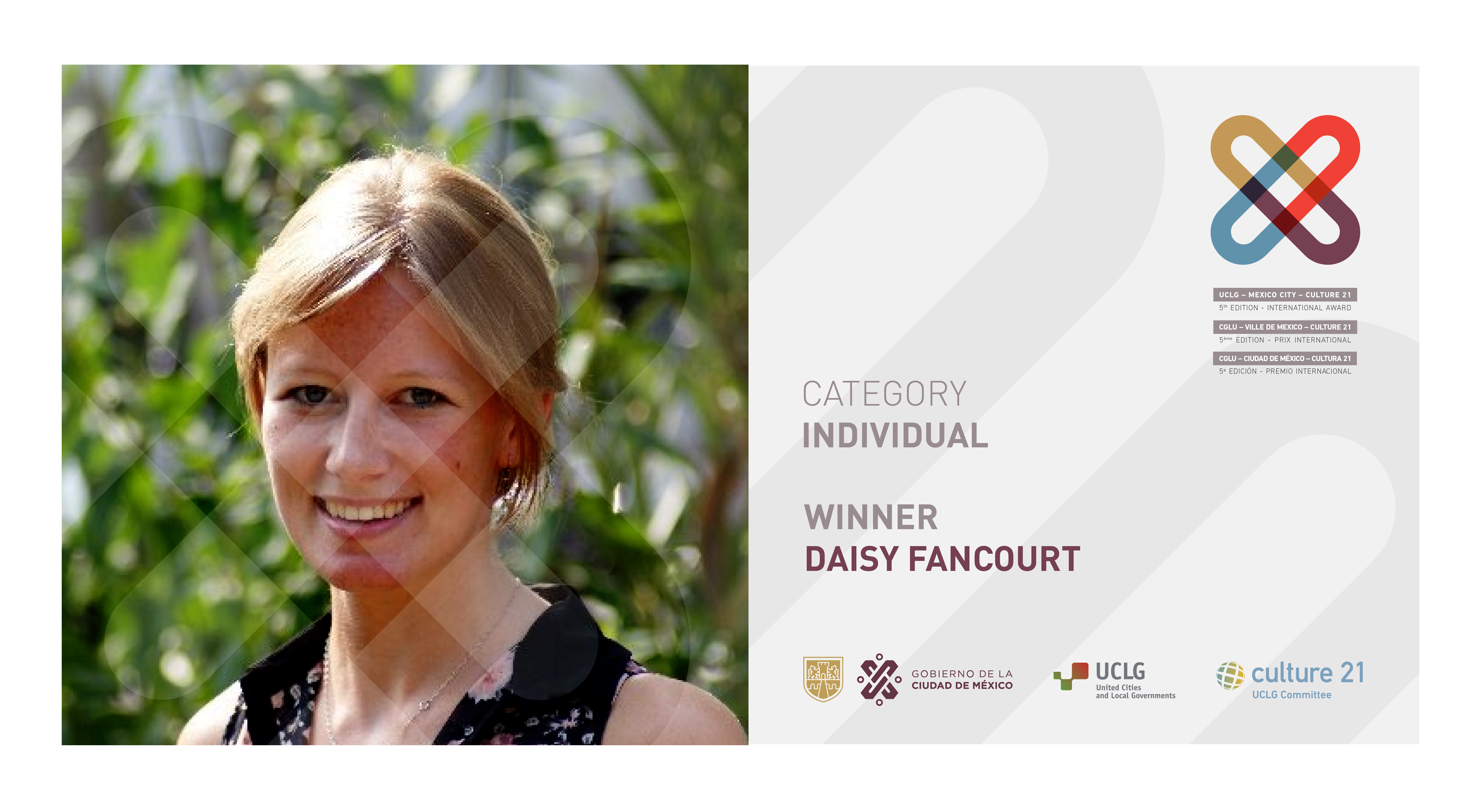


Daisy Fancourt
The work of Dr Daisy Fancourt has decisively contributed to prove the benefits of cultural activities for people’s health. She is Associate Professor of Psychobiology & Epidemiology and Head of the Social Biobehavioural Research Group at University College London. She studied at Oxford University and King’s College London before completing her PhD in psychoneuroimmunology at University College London. Her research focuses on the effects of social factors on health, including social deficits (e.g. loneliness and social isolation) and sociocultural assets (e.g. community engagement, arts & cultural activities, and social prescribing). Dr Daisy Fancourt is also the Director of the World Health Organisation Collaborating Centre on Arts and Health (www.artshealthcc.org) as well as a member of the WHO Technical Advisory Group on cultural and behavioural insights on health.
The report “What is the evidence on the role of the arts in improving health and well-being? A scoping review”, based on the review of over 3000 studies was worldwide disseminated and acclaimed. The report and subsequent theoretical work from Dr Fancourt has shown that arts and culture combine many different components (‘active ingredients’) that are beneficial to health, for example involving the imagination, sensory activation, cognitive stimulation and social interaction. In further work published in the Lancet Psychiatry, Dr Fancourt has then shown that these components can prompt over 600 different psychological, physiological, social and behavioural mechanisms which are linked-in with the prevention, management and treatment of a range of different health conditions. Through Dr Fancourt’s publications, the beneficial impact of cultural activities has a renewed scientific evidence base. The promoting of artistic and cultural engagement at the individual, local and national levels is becoming essential in public policies for sustainable development.
See the biography of Dr. Daisy Fancourt.
See the article elaborated by Dr. Daisy Fancourt and her teams.